
Tuesday, January 29, 2013
Who needs a Thigh Master?
A healthy elephant is a clean elephant so next on the agenda was to learn some basic elephant skin care. Apparently elephants don't sweat like humans, excluding sweat only at the point on their body that their toenails join their foot. If you look carefully you will see a sweat band at this point.
An elephants skin is approximately two inches thick, except for behind the ears. Here it is half an inch thick carrying lots of blood vessels which are used by the elephant as a cooling system when it flaps it's ears. The breeze created helps to cool the blood before it circulates further. Pretty neat. Their skin, needs to be kept clean in order to more easily check the elephants health and condition. Another key cooling mechanism is to throw dust up and over their back from their trunks. This accumulation of dust, twigs and potential insects is easily removed via scrubbing. First off there is a manic slapping of a hand held "brush" made from bunches of leaves. slap, slap, slap, to cries of "harder, harder" from Benz. as far as brooms go though it worked a treat with dust and grime vanishing with each swoosh. Then off to the pond we went with bamboo bucket, scrubbing brush and swatch of tree bark which believe it or not makes a form of natural soap once wet and rubbed harshly across the elephants skin.
 Elephants into the water, people into the water and lots of splashing to follow. The scrubbing is actually hard work, and to do it properly you actually have to scrub hard, except for around the eyes. There is also directional attention to be paid, following the grain so the speak. Except for the exceptions like the trunk where it seems to be ok to scrub across the grooves. Much more exertion required than you think. Working with elephants definitely has it over Weight Watchers or a Thigh Master. It is hard work, strenuous, physically demanding and I am sure that I will twinge as I move tomorrow.
28.1.2013
Elephants into the water, people into the water and lots of splashing to follow. The scrubbing is actually hard work, and to do it properly you actually have to scrub hard, except for around the eyes. There is also directional attention to be paid, following the grain so the speak. Except for the exceptions like the trunk where it seems to be ok to scrub across the grooves. Much more exertion required than you think. Working with elephants definitely has it over Weight Watchers or a Thigh Master. It is hard work, strenuous, physically demanding and I am sure that I will twinge as I move tomorrow.
28.1.2013

How to climb onto an elephant


Elephant school continues


Your elephant chooses you
Next it was on to learning how to determine which elephant would be ours for the day. The trick to elephant allocation, according to our guide Benz, was to feed an elephant for five minutes. By this time, he would have a clear indication of whether "our" elephant would accept us - or not.
 So, first to be allocated an elephant was me. I followed Benz with a basket of bananas, to find myself stationed in front of the biggest elephant I have ever seen in my life. He was huge, and yes, he was a male. He also had the biggest tusks I have ever seen, and was in fact the only elephant with tusks. So, five minutes later, after he had demolished all of the sugar cane and bananas I looked to Benz to see whether I was "in". Sure enough this huge guy accepted me, so from that point on Boon Pat and I were buddies for the day. Well, Boon Pat and I and our personal trainer, and what a day it was!
28.1.2013
So, first to be allocated an elephant was me. I followed Benz with a basket of bananas, to find myself stationed in front of the biggest elephant I have ever seen in my life. He was huge, and yes, he was a male. He also had the biggest tusks I have ever seen, and was in fact the only elephant with tusks. So, five minutes later, after he had demolished all of the sugar cane and bananas I looked to Benz to see whether I was "in". Sure enough this huge guy accepted me, so from that point on Boon Pat and I were buddies for the day. Well, Boon Pat and I and our personal trainer, and what a day it was!
28.1.2013

Patara Elephant Farm
Today was our first visit to see the elephants that Chiang Mai is so famous for. Scheduled to visit Patara Elephant Farm, we were picked up by our driver at 7.30am with a trip of about an hour ahead of us. I am finding the view from a vehicle, out into the world, an entertaining one, so happily spent the trip peering out at the traffic chaos surrounding us.
We arrived at Patara and the fun began. We were barely out of the car and the elephants being brought in to work with us for the day came past us and down the hill. These animals really are incredible. So huge, up close, but also exuding a calm presence. It was inspiring just to be near these animals, knowing that they would accept us as part of their world for the day.
Other couples joining us for the day were from all over the world. In our group we had two couples from Bordeaux, France; one from New York and one from the UK. So, with Frank and I from Australia, a truly international bunch.
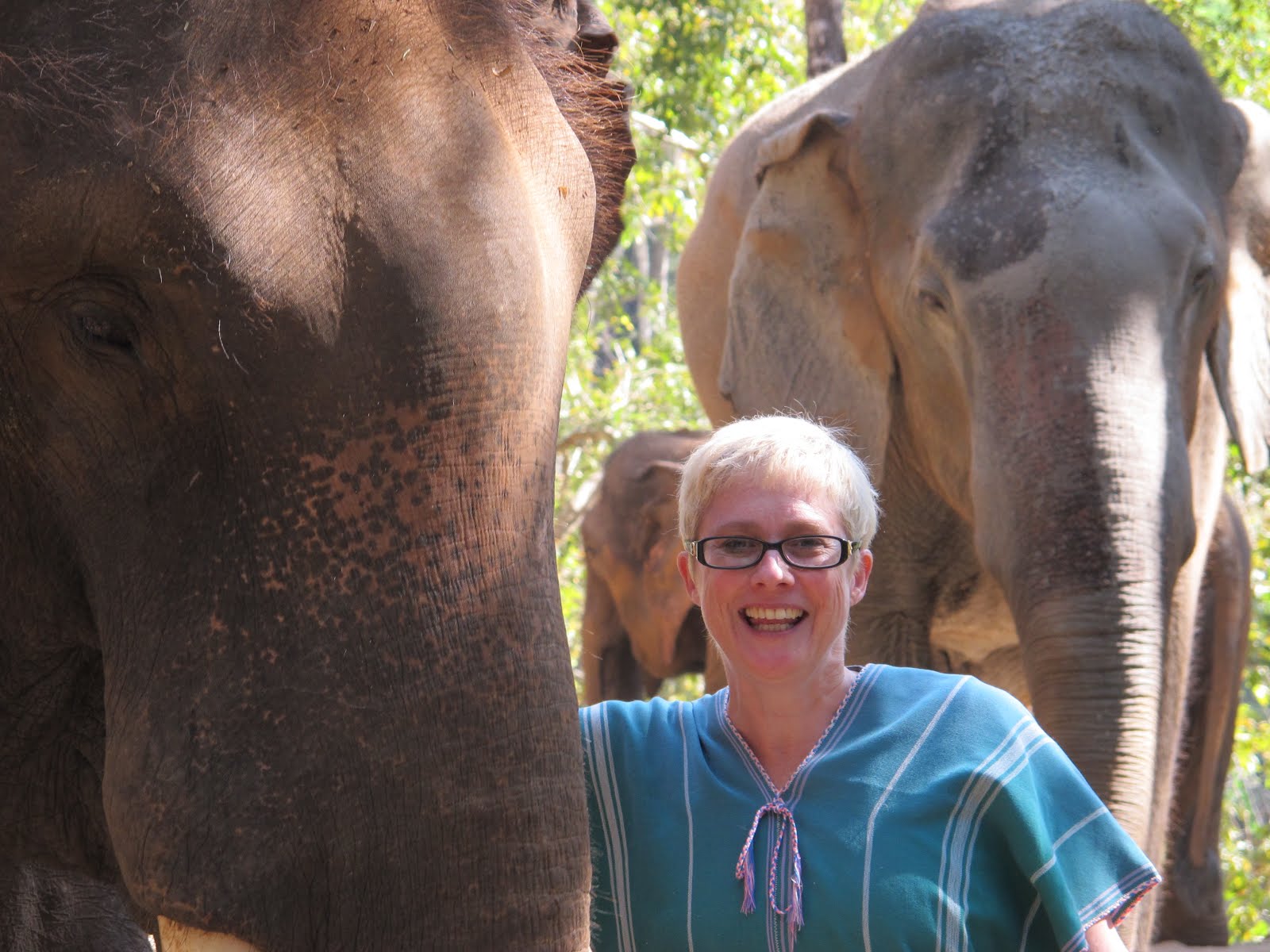
The local Karen tribespeople from the mountains of Burma Thai border region of Chiang Mai are the traditional elephant keepers of the Mai Sim area. These people are also known for their beautiful woven fabrics, so it was no surprise to see we were allocated a cotton tunic each to wear for the day. The official reason give was that the elephants would "see" us as a Karen trainer. Somehow I think that the elephants were to smart to be caught out by this....apart from the fact that when we went swimming we all took our tunics off!
So, we passed around the bundle of tunics, selecting whichever colour appealed to us. For some reason, although I am usually a red girl, I selected a green tunic, only to be told that "elephants like green, because they think of you as a banana leaf". I responded "Great - I'm dressed as elephant food!" Everyone laughed.
 We all had a chance to feed some sugar cane to one elephant who had very kindly stopped for us, then it was over to "elephant school" for a while. The trainers were great, taking great care to teach us how to recognise the signs of a "happy" elephant. So, flapping ears and swinging tail are good. You can approach, touch and feed the elephant. If you don't see these signs, don't go near them. Elephants too have bad days, mostly for the females as they can get hormonal as part of their cycle. Makes sense, especially when you realise that a pregnant elephant has up to 24 months gestation for a male calf, and slightly less (a month or so) for a female calf. The things you learn.
28.1.2013
We all had a chance to feed some sugar cane to one elephant who had very kindly stopped for us, then it was over to "elephant school" for a while. The trainers were great, taking great care to teach us how to recognise the signs of a "happy" elephant. So, flapping ears and swinging tail are good. You can approach, touch and feed the elephant. If you don't see these signs, don't go near them. Elephants too have bad days, mostly for the females as they can get hormonal as part of their cycle. Makes sense, especially when you realise that a pregnant elephant has up to 24 months gestation for a male calf, and slightly less (a month or so) for a female calf. The things you learn.
28.1.2013
Monday, January 28, 2013
Dog days

Road chaos in Chiang Mai
Negotiating traffic in Chiang Mai takes some skill. So does being a passenger. Culture shock for me so far starts and ends with the type, style, quantity and dress style of the population as they traverse the road system. Where to begin?
Utes are used to transport goods - say a truck load of cabbages. And I do mean a truck load. Imagine if you can a semi trailers worth of cabbages, balanced so symmetrically you can stack them all into the tray of a ute. Tie it down with a piece of string and you will begin to get the picture. Utes are also used to carry building materials. Large, long loads, without the usual red rag to alert unsuspecting vehicles following behind that they might in fact get dinged on the head.
Then there was the ute with boxes stacked five high. I kid you not! This guy was actually quite organised as he had a cargo net of sorts holding the whole lot in. As for people - current record is 9 being transported in the back of a ute. Usually anything up to five is viable as a workmate takes his buddies to work with him.

 These too images were taken in Koh Samui, just shows it is atypical Thai thing. Crazy, but a common occurence.
Taxis too are quite unique. The Blue and Gold seem almost normal. The Red taxis however appear more like cut down ambulances. Open backed, with rows of seats running up the interior they transport locals and tourists alike, catering for about ten passengers. Dodging in and out of the traffic with passengers clinging on, like a mini bus. Pull up behind one in the traffic and you look right in on everyone, quite a weird feeling after the impersonal buses at home.
These too images were taken in Koh Samui, just shows it is atypical Thai thing. Crazy, but a common occurence.
Taxis too are quite unique. The Blue and Gold seem almost normal. The Red taxis however appear more like cut down ambulances. Open backed, with rows of seats running up the interior they transport locals and tourists alike, catering for about ten passengers. Dodging in and out of the traffic with passengers clinging on, like a mini bus. Pull up behind one in the traffic and you look right in on everyone, quite a weird feeling after the impersonal buses at home.
 Tuk tuks, quite common in the city itself are less evident where we currently are about 40 minutes out of town. With the driver up front and two or three squeezed in the back, these are unlike anything at home and have to be seen to be believed.
That leaves the motorbikes and scooters. Some single units, some with a cage type sidecar that transports goods or passengers. They are almost awe inspiring in the way they are utilised. That said, you wouldn't get me on one in a pink fit. At home, riding pillion with someone I trust - sure. Here in this crazy dodge city of vehicles, no way.
Tuk tuks, quite common in the city itself are less evident where we currently are about 40 minutes out of town. With the driver up front and two or three squeezed in the back, these are unlike anything at home and have to be seen to be believed.
That leaves the motorbikes and scooters. Some single units, some with a cage type sidecar that transports goods or passengers. They are almost awe inspiring in the way they are utilised. That said, you wouldn't get me on one in a pink fit. At home, riding pillion with someone I trust - sure. Here in this crazy dodge city of vehicles, no way.

 So, if a sidecar is attached expect to see goods being transported. More often than not, the passengers are often riding pillion rather than in the cage. Best example of versatility for this style of whichever to date is driver plus two passengers riding pillion with an empty cage. Maybe they were e route to pick up a load? Who knows.
Motorbikes and scooters are the general workhorse of choice. Favourite sights so far include the following: the guy driving his bike wearing a fluffy elephant hat, complete with trunk waving as he took off from the traffic lights; the guy riding his motorbike with his dog standing on its hind legs with its front legs resting on the handlebars and the couple ring their bike with their puppy on her lap as he drove, safely squeezed between them.
The ultimate sit however was the family with Dad driving, Mum was riding pillion, between them were two children, but out in front of Dad, was a third child. None wore helmets. Although I have seen street side stalls selling bike helmets it seems to be considered the norm to ride without one. Go figure.
28.1.2013
So, if a sidecar is attached expect to see goods being transported. More often than not, the passengers are often riding pillion rather than in the cage. Best example of versatility for this style of whichever to date is driver plus two passengers riding pillion with an empty cage. Maybe they were e route to pick up a load? Who knows.
Motorbikes and scooters are the general workhorse of choice. Favourite sights so far include the following: the guy driving his bike wearing a fluffy elephant hat, complete with trunk waving as he took off from the traffic lights; the guy riding his motorbike with his dog standing on its hind legs with its front legs resting on the handlebars and the couple ring their bike with their puppy on her lap as he drove, safely squeezed between them.
The ultimate sit however was the family with Dad driving, Mum was riding pillion, between them were two children, but out in front of Dad, was a third child. None wore helmets. Although I have seen street side stalls selling bike helmets it seems to be considered the norm to ride without one. Go figure.
28.1.2013


Subscribe to:
Posts (Atom)
.JPG)
